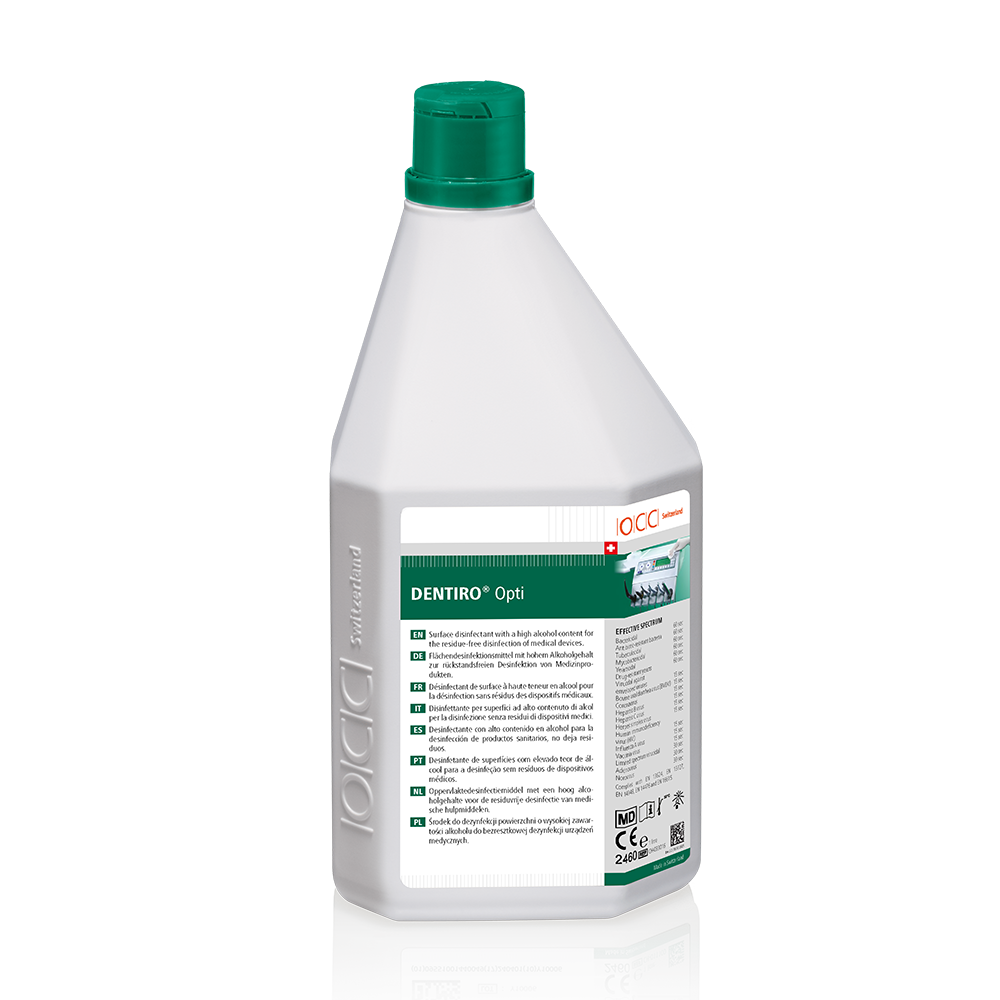
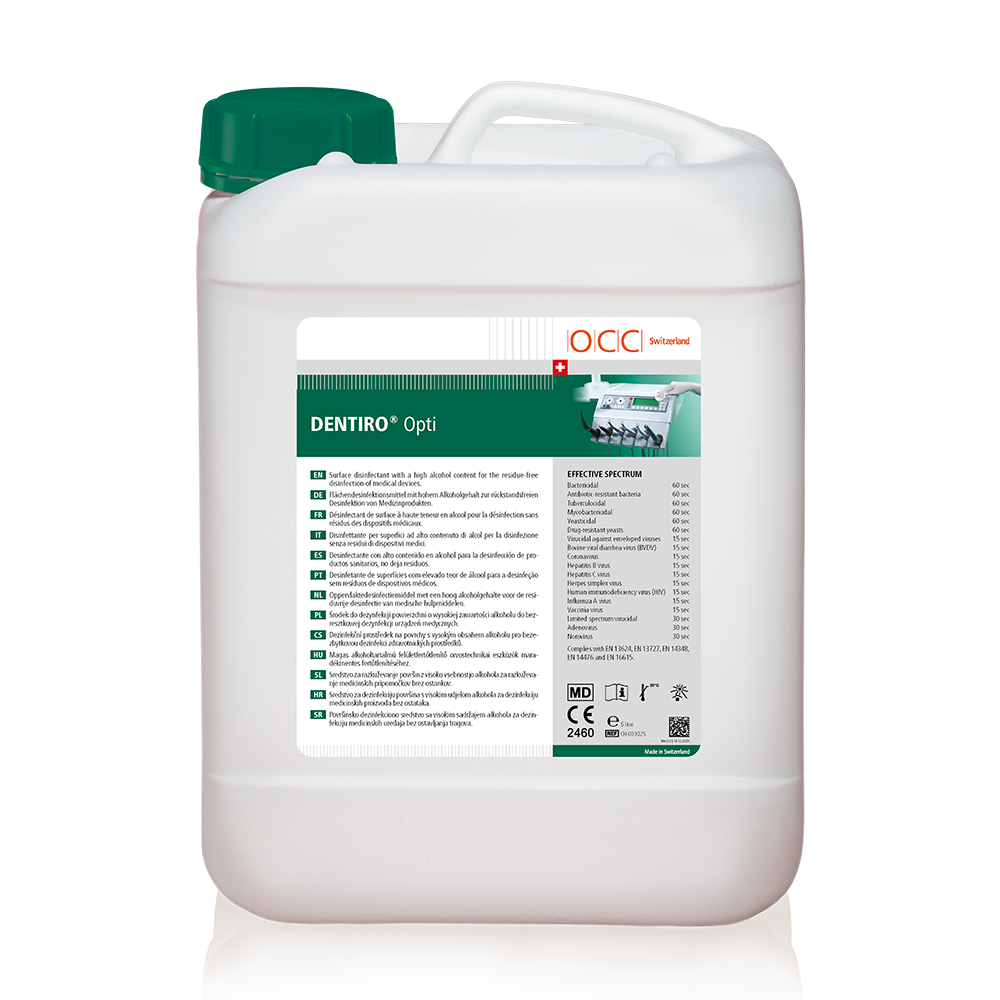
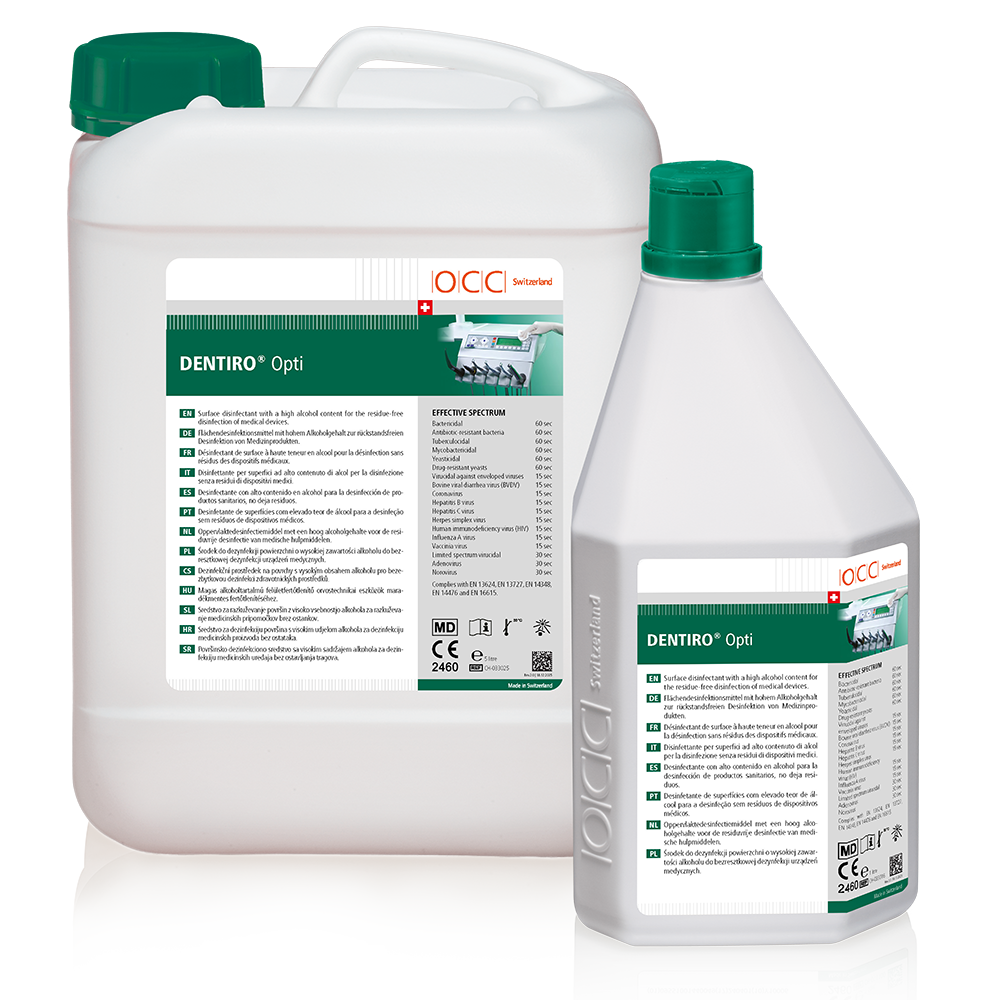
DENTIRO® Opti

DENTIRO® Opti is a surface disinfectant with a high alcohol content suitable for the rapid and residue-free disinfection of alcohol-resistant surfaces of non-invasive medical devices such as operating tables and IV poles.
Delivery forms
Documents
Where to buy
Ensuring the Compatibility of Our Disinfectants Is a Top Priority
While no disinfectant can guarantee absolute compatibility with all materials, our rigorous in-house testing, strategic collaborations with medical device manufacturers, and stringent external testing at ISO 17025 accredited laboratories for final material compatibility evaluations-affirm that our disinfectants are exceptionally suited for a broad spectrum of surfaces, encompassing various metals, plastics, and polymers.

The Diversity of Materials in Healthcare - From Metals and Plastics to Polymers - Makes Compatibility with Disinfectants Crucial
Recognizing and addressing material incompatibilities is crucial in the medical industry. Disinfectants that are not compatible with certain materials can trigger stress cracks in equipment, accelerating wear and tear and shortening their usable lifespan. Moreover, these cracks become breeding grounds for pathogens, rendering the disinfection processes ineffective. The longevity and functionality of medical devices hinge not just on the quality of their construction, but also on the interplay between the materials they are made of and the disinfectants used on them.
The Challenge of Environmental Stress Cracking
Environmental stress cracking presents a major issue in healthcare. When materials, notably plastics and polymers, come into contact with certain disinfectants, they can weaken and prematurely become brittle. The result is not just equipment that wears out faster but surfaces that become challenging to disinfect, turning into safe havens for pathogens.
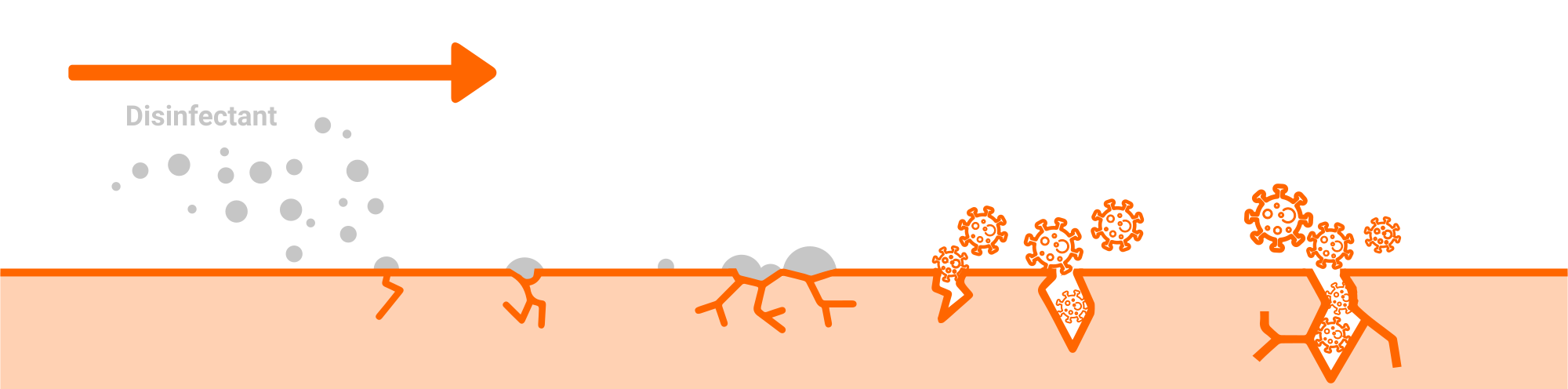
This issue stems from the myriad of chemical structures that fall under the ❬ plastics ❭ and ❬ polymers ❭ categories. While device manufacturers choice of materials is influenced by their physical attributes, cost-effectiveness, and availability, the resilience to disinfectants is vital for patient safety.
On the other hand, disinfectants, which are made of active compounds, solvents, and other additives, need to strike a balance between eradicating microbes and not causing material damage. A lapse in this balance can lead to ❬ environmental stress cracking ❭, which weakens plastics prematurely. Prolonged exposure to certain disinfectants can alter polymer structures, making them brittle. Amines, for instance, are notably harsh on some plastics. The consequence? Deepening cracks in equipment, providing hiding spots for pathogens and undermining disinfection.
So what can be done? The remedy lies in a collaborative effort. While surface and device manufacturers should prioritize robust, durable materials, disinfectant producers must innovate with formulations that are gentler on surfaces, without compromising efficacy. At Oro Clean Chemie AG, our commitment echoes this principle, ensuring our disinfectants are both potent and compatible, so you never have to choose between clinical efficacy and equipment longevity.
Getting the Most Out of DENTIRO® Opti
Intended Users
The product is intended for use by dental or healthcare professionals with knowledge about the disinfection of medical devices. The product is not to be used directly on patients.
Instructions for Use
For your protection, wear disposable gloves and safety goggles. Completely moisten and wipe the entire surface of the medical device. Leave disinfectant to act and adhere to contact time. Use on alcohol compatible materials only. Before first time use, test material compatibility by applying the disinfectant to a small inconspicuous area. A list of compatible and incompatible materials is available on our website. If you are uncertain as to the material composition of the medical device, contact the manufacturer before use. Any serious incident that has occurred in relation to the device should be reported to the manufacturer and the competent authority of the Member State in which the user and/or patient is established.
Limitations
FOR PROFESSIONAL USE ONLY. Not for use on invasive medical devices. Do not mix with other products. Make sure that all visible soiling has been removed before disinfection.
Handling
Danger H226 Flammable liquid and vapour. H318 Causes serious eye damage. H336 May cause drowsiness or dizziness. P210 Keep away from heat, hot surfaces, sparks, open flames and other ignition sources. No smoking. P233 Keep container tightly closed. P261 Avoid breathing fume/mist/vapours/spray. P280 Wear protective gloves/protective clothing/eye protection/face protection. P305 + P351 + P338 IF IN EYES: Rinse cautiously with water for several minutes. Remove contact lenses, if present and easy to do. Continue rinsing. P501 Dispose of contents/container in accordance with local and national regulations. For more information, please refer to Safety Data Sheet available on our website.


Accessories and Application Aids
User Friendly Packaging
Packaging Details
 Primary Packaging
 Secondary Packaging
 Pallet
Discover More About DENTIRO® Opti
Composition in 100g
100 g contains 25 g ethanol, 35 g 1-propanol, auxiliaries and water.
Physical and Chemical Properties
Industries

Dental

Food Production

Beauty and Wellness

Hospitality

Leisure

Medical

Pharma

Nursing

Public Sector

Retail

Travel and Transportation

Veterinary
Ensuring the Compatibility of Our Disinfectants Is a Top Priority
While no disinfectant can guarantee absolute compatibility with all materials, our rigorous in-house testing, strategic collaborations with medical device manufacturers, and stringent external testing at ISO 17025 accredited laboratories for final material compatibility evaluations-affirm that our disinfectants are exceptionally suited for a broad spectrum of surfaces, encompassing various metals, plastics, and polymers.
Note
-

No visible surface damage or effect on the material is likely to occur when used according to label directions. No change to the integrity of the material is expected.
-
Some visible surface damage such as tarnishing or clouding may be seen with long-term exposure. Little to no effect on material intergrity is expected. Periodic wiping of surfaces with a clean damp cloth to remove residue can help to minimize damage.
-
Visible damage to the surface is likely to occur with long-term exposure and some effect on material integrity is possible. Surfaces should be wiped with a clean damp cloth immediately after the contact time has been reached to reduce the risk of damage. Users should evaluate the risk of surface damage vs the benefits of disinfectant efficacy against pathogens to determine whether the products is appropriate for use.
The Diversity of Materials in Healthcare - From Metals and Plastics to Polymers - Makes Compatibility with Disinfectants Crucial
Recognizing and addressing material incompatibilities is crucial in the medical industry. Disinfectants that are not compatible with certain materials can trigger stress cracks in equipment, accelerating wear and tear and shortening their usable lifespan. Moreover, these cracks become breeding grounds for pathogens, rendering the disinfection processes ineffective. The longevity and functionality of medical devices hinge not just on the quality of their construction, but also on the interplay between the materials they are made of and the disinfectants used on them.
The Challenge of Environmental Stress Cracking
Environmental stress cracking presents a major issue in healthcare. When materials, notably plastics and polymers, come into contact with certain disinfectants, they can weaken and prematurely become brittle. The result is not just equipment that wears out faster but surfaces that become challenging to disinfect, turning into safe havens for pathogens.
This issue stems from the myriad of chemical structures that fall under the ❬ plastics ❭ and ❬ polymers ❭ categories. While device manufacturers choice of materials is influenced by their physical attributes, cost-effectiveness, and availability, the resilience to disinfectants is vital for patient safety.
On the other hand, disinfectants, which are made of active compounds, solvents, and other additives, need to strike a balance between eradicating microbes and not causing material damage. A lapse in this balance can lead to ❬ environmental stress cracking ❭, which weakens plastics prematurely. Prolonged exposure to certain disinfectants can alter polymer structures, making them brittle. Amines, for instance, are notably harsh on some plastics. The consequence? Deepening cracks in equipment, providing hiding spots for pathogens and undermining disinfection.
So what can be done? The remedy lies in a collaborative effort. While surface and device manufacturers should prioritize robust, durable materials, disinfectant producers must innovate with formulations that are gentler on surfaces, without compromising efficacy. At Oro Clean Chemie AG, our commitment echoes this principle, ensuring our disinfectants are both potent and compatible, so you never have to choose between clinical efficacy and equipment longevity.
Getting the Most Out of DENTIRO® Opti
Intended Users
The product is intended for use by dental or healthcare professionals with knowledge about the disinfection of medical devices. The product is not to be used directly on patients.
Instructions for Use
For your protection, wear disposable gloves and safety goggles. Completely moisten and wipe the entire surface of the medical device. Leave disinfectant to act and adhere to contact time. Use on alcohol compatible materials only. Before first time use, test material compatibility by applying the disinfectant to a small inconspicuous area. A list of compatible and incompatible materials is available on our website. If you are uncertain as to the material composition of the medical device, contact the manufacturer before use. Any serious incident that has occurred in relation to the device should be reported to the manufacturer and the competent authority of the Member State in which the user and/or patient is established.
Limitations
FOR PROFESSIONAL USE ONLY. Not for use on invasive medical devices. Do not mix with other products. Make sure that all visible soiling has been removed before disinfection.
Handling
Danger H226 Flammable liquid and vapour. H318 Causes serious eye damage. H336 May cause drowsiness or dizziness. P210 Keep away from heat, hot surfaces, sparks, open flames and other ignition sources. No smoking. P233 Keep container tightly closed. P261 Avoid breathing fume/mist/vapours/spray. P280 Wear protective gloves/protective clothing/eye protection/face protection. P305 + P351 + P338 IF IN EYES: Rinse cautiously with water for several minutes. Remove contact lenses, if present and easy to do. Continue rinsing. P501 Dispose of contents/container in accordance with local and national regulations. For more information, please refer to Safety Data Sheet available on our website.
Accessories and Application Aids
User Friendly Packaging
Packaging Details
Primary Packaging Secondary Packaging PalletDiscover More About DENTIRO® Opti
Composition in 100g
100 g contains 25 g ethanol, 35 g 1-propanol, auxiliaries and water.
Physical and Chemical Properties
Industries
Dental
Food Production
Beauty and Wellness
Hospitality
Leisure
Medical
Pharma
Nursing
Public Sector
Retail
Travel and Transportation